The Little Town That Chose Freedom

Every June, rainbow flags begin to appear across Sitges.
Visitors arrive from around the world. Beaches become livelier, terraces stay busy long into the evening, and the town prepares for another edition of Sitges Pride, taking place this year from June 10th to June 14th, 2026.
For many people, Sitges is now synonymous with Pride, inclusivity and one of Europe’s most welcoming LGBTQ+ communities.
Yet the truth is that Sitges did not become open-minded because of Pride.
Pride came to Sitges because the town was already open-minded.
That distinction matters.
The story begins long before rainbow flags, long before social media, and even long before mass tourism transformed the Mediterranean.
At the end of the nineteenth century, Sitges was still a relatively modest fishing town. What changed its destiny was not industry or commerce, but culture. Artists, writers and intellectuals began arriving, attracted by the extraordinary Mediterranean light and the relaxed atmosphere of the town.
Among them was Santiago Rusiñol, one of the leading figures of Catalan Modernism. His arrival helped transform Sitges into a cultural centre where painters, collectors, poets and free thinkers gathered to exchange ideas. Long before anyone spoke about diversity or inclusion, Sitges had already developed a reputation as a place where people who felt different could find their place.
The town was also shaped by the so-called Indianos, Catalans who had emigrated to Cuba and returned with fortunes that helped transform the architecture of Sitges. Their elegant villas, eclectic façades and cosmopolitan outlook left a lasting mark on the town. What emerged was something unusual for a small Mediterranean community: a place deeply attached to its traditions yet remarkably receptive to outside influences.
That balance would prove important in the decades to come.

How Sitges Remained Different During Franco’s Spain
When Spain entered the Franco era, much of the country became socially conservative and tightly controlled. Yet Sitges somehow managed to preserve a degree of freedom that felt unusual for the time.
There was no official declaration and no grand political statement. Instead, several factors quietly converged. The town already had an established artistic community. Foreign visitors continued to arrive. Tourism became increasingly important to the local economy. Sitges developed a reputation as a place where authorities often preferred pragmatism to confrontation, especially when visitors brought cultural energy and economic activity.
This did not make Sitges a paradise of freedom. Spain remained a dictatorship and many forms of discrimination persisted. Yet compared to much of the country, Sitges felt different. Many artists, creatives, foreigners and members of the LGBTQ+ community sensed that difference and gravitated toward it.
Over time, that informal culture of tolerance became part of the town’s identity. It was not built through slogans or marketing campaigns. It emerged organically through decades of encounters, artistic expression, international influences and a collective habit of letting people live as they wished.
A Town That Knows How to Celebrate Life
Freedom in Sitges has never been limited to ideas. It has always been expressed through celebration.
The town is famous for its Carnival, one of the most vibrant and colourful in Europe. The Sitges International Fantastic Film Festival attracts cinema lovers from around the world every autumn. Summer evenings naturally spill from cafés to terraces and from terraces to late-night conversations.
Few visitors realise that even the story of Mediterranean nightlife passes through Sitges. The very first Pacha nightclub opened here before the brand became forever associated with Ibiza. Long before beach clubs and destination nightlife became fashionable, Sitges already understood the art of enjoying life.
Yet what makes the town truly unique is that freedom never replaced tradition. The two evolved together.
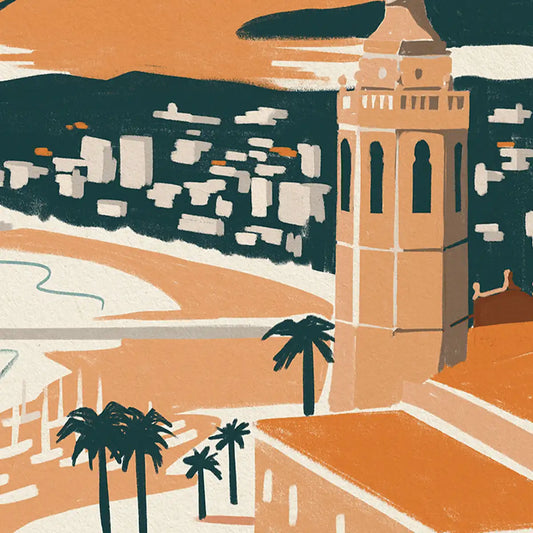
The Festa Major remains one of the most important celebrations of the year. Castellers, giants, dragons, fireworks and religious processions continue to fill the streets. The silhouette of Sant Bartomeu i Santa Tecla remains the defining image of Sitges and one of the most recognisable landmarks on the Mediterranean coast.
That coexistence between heritage and openness may be the town’s greatest achievement.
Why Pride Feels So Natural in Sitges
Today, Sitges hosts several internationally recognised LGBTQ+ events, including Sitges Pride, the Bears Sitges Meeting and the famous Bears Week.
What makes these celebrations special is not simply their scale. It is the fact that they feel authentic. They reflect values that have become deeply embedded in the town’s character: respect, inclusion and the freedom to live authentically.
For many residents and returning visitors, the rainbow flag has become more than a symbol of Pride. It has become a symbol of the welcoming spirit that defines Sitges throughout the year.
The Inspiration Behind Sitges Rainbow

It is this unique balance between tradition and openness that inspired Sitges Rainbow, Cha’s latest addition to the City Lines series within her Spanish Capsule™ collection.
At first glance, the artwork feels simple. The iconic church remains exactly where every Sitgetà expects to find it, standing proudly above the town. The architecture is preserved. The familiar silhouette remains untouched. The history of Sitges stays firmly in place.
Behind it unfolds a carefully composed rainbow palette.
Not a loud statement. Not a confrontation. Simply an elegant tribute to one of the values that has helped define Sitges for generations.
In many ways, the poster reflects the town itself.
Tradition remains at the centre.
Openness forms the backdrop.
The church belongs to everyone.
The town welcomes everyone.
Rendered in Cha’s distinctive graphic style, Sitges Rainbow transforms one of the world’s most recognisable symbols of Pride into something softer, more decorative and deeply rooted in the identity of Sitges itself.
As Sitges prepares to welcome Pride visitors once again this June, the poster serves as a reminder that what people celebrate here is not only diversity, but a long tradition of freedom, creativity and coexistence.
Perhaps that is why so many visitors arrive for a weekend and end up returning year after year.
Because beyond the beaches, beyond the festivals and beyond the nightlife, Sitges offers something increasingly rare in the modern world.
A place where freedom feels natural.
Sitges Rainbow by Cha is available now as a limited edition of 300 prints across all sizes through MyRetroPoster galleries and later online.